

I called this post categories of creativity, because it’s not categories of innovation, which don’t really exist.
Assessing a creative idea, an idea that is intentionally novel, as innovative is a subjective judgement, usually over a long period of time, about the value of that idea.(1)
Innovation is not something to spend much time on, because your subjectivity and my subjectivity are probably quite different.
However, I am a firm believer in structured methods of creativity that can be categories, and they can be learned, taught, and shared.
My own experiences points to three major categories of creativity, all of which can be applied in a structured way so we don’t need to rely on mythical beliefs about the sources of creativity. There are no flashes of brilliance here.
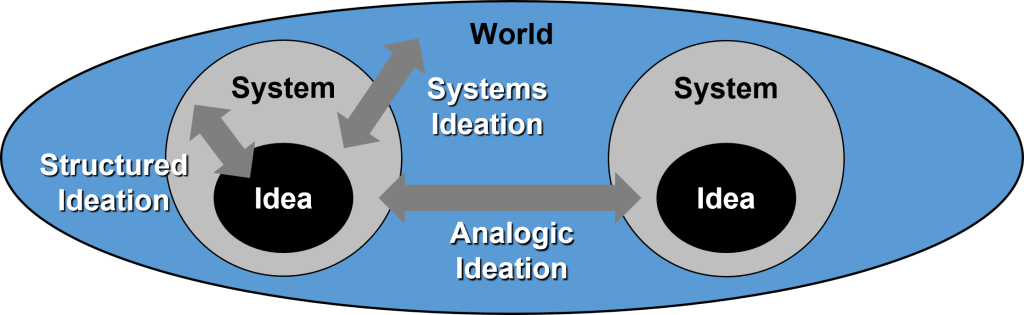
The three categories are show in the image above.
Stated simply, every idea exists within a system, and the world contains lots of systems.
Ideas interact with their system and are generally constrained by that system. It is that changing constraint that creates the need for new creativity within or around that idea.
Arbitrarily labeling them, Category A concerns generation of or changes to an idea itself. Here, we can apply many techniques, but my favorite is Systematic Inventive Thinking, which is derived from TRIZ, and may incorporate MATCEMIB, as well. All valid and structured approaches.
Category B is the generation of or changes to an idea based on analogies to or alignment with ideas found in other systems. There’s a lot written on analogic or analogical thinking, but a good summary was provided in this recent article that highlights the how’s and why’s of this structured method.
Finally, Category C is the generation of or changes to an idea based on global alignment or constraints. This is generally called Systems Thinking.
And the beauty of these categories is that they can be imposed on ideas, not just hoped for or believed in. We can drive them forward and backward. We can combine them internally, recursively, and together across the categories.
One common thread through all of these is constraint. It’s said that necessity is the mother of invention, but in truth, were it not for constraint, no amount of necessity would be sufficient. It is constraint that causes the need for and thus generation of a novel idea. And it is constraint that brings about the other requirement for creativity, that it be intentional, and not the result of some random, unpredictable event.
Thus, what we have is a logical framework of structured creativity techniques that aid in their application and in being able to remember them.
I invite you to use them and to remember them.
 Jim McLaughlin's Blog